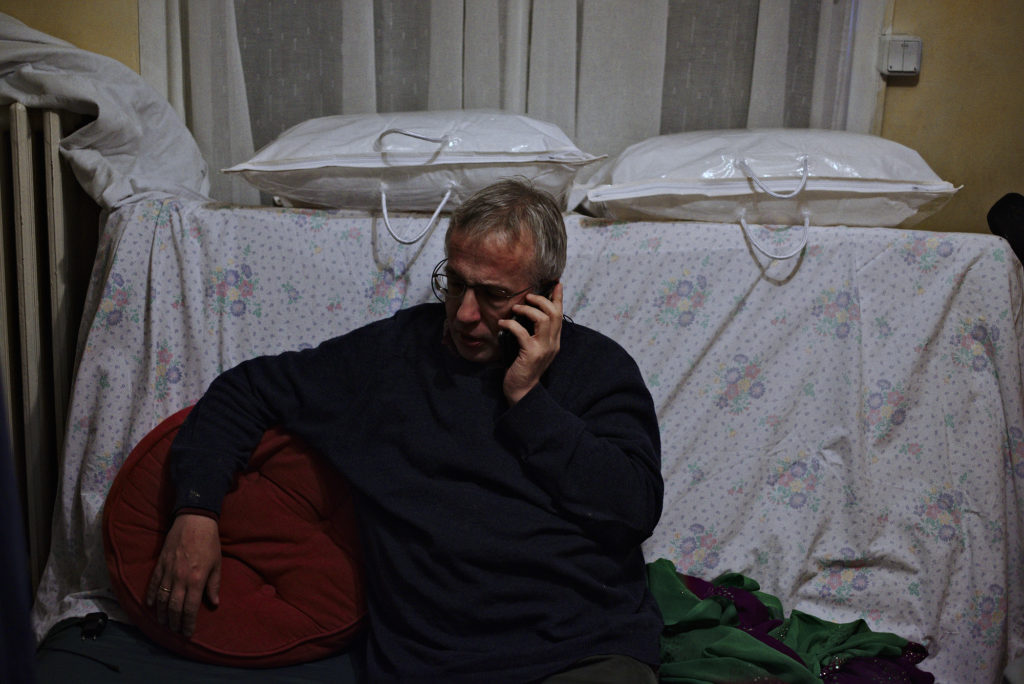
photo oct. 2019 by Matthieu Starynkevitch
By personal experience, Covid19 is a tiring illness.
My current pet open source project is RefPerSys (a Ref-lexive Per-sistent Sys-tem), a GPLv3+ licensed software (on gitlab.com/bstarynk/refpersys) and work in progress. It is a symbolic artificial intelligence open source system for Linux, notably inspired by the ideas of the late Jacques Pitrat (1934-oct.2019). I recommend reading his last book Artificial Beings: the Conscience of a Conscious Machine (ISBN 978-1848211018) whose ideas are very inspirational for RefPerSys. Potential applications, use-cases and tests, contributions, and limited funding (in particular thru future HorizonEurope research projects, or otherwise) could be welcome. Contact me -in written English, French, or Russian- by UTF-8 encoded email to basile@starynkevitch.net mentioning RefPerSys in the email subject.
My resume in English is here (PDF). I am considering starting some freelancing activity
Une version française de cette page est disponible.
This page (written in English, which is not my native tongue) is downloadable from starynkevitch.net/Basile/index_en.html. Opinions expressed here are only mine. A French and improved variant (with much more political and philosophical opinions) is on starynkevitch.net/Basile/.
On my spare time, I am working, with other persons, on RefPerSys, an ambitious artificial intelligence free software research project (not yet funded at start of 2020).
I am interested in job (or even freelance consultancy) opportunities in the Euro zone, provided partial tele-commuting or remote work is possible (since I am happily married, and my dear wife is an independent psychotherapist working at home and I really do want to see her a bit more than just on week-ends). My resume in English is here. My technical interests include Machine Learning, Artificial Intelligence, Big Data, Data Science, Cloud Computing, Web technologies, Distributed Computing, Cybersecurity, Program analysis, Software Engineering, Open source software and the ability to learn and teach stuff at work, then design and develop challenging software systems (for Linux computers) from what I did learn. I need technical discussions and could take a technical lead role in a small team (with almost no management work). I am definitely a geek so please contact me by email to basile@starynkevitch.net or basile.starynkevitch@gmail.com.
Partner Search for ICT16-2018 H2020 European call for proposal (collaborative research project idea). That proposal got funding and should start in 2019 as the DECODER project.
photo oct. 2019 by Matthieu Starynkevitchmy resume is here. My contact information is included.
My name in Russian: Василий Дмитриевич Старынкевич . My late parents spoke Russian to me, and repeated perhaps weekly when I was a kid : Век живи - век учись (literally: if you live a century, you have to learn during a century). I still remember that lesson every single day.

My main selfish interest is -since decades- about reflexive and persistent systems, using meta-programming techniques and knowledge based approach (I have had that interest since before my PhD). But it is difficult to find funding on these ideas alone. Static source code analysis feeds me, but interests me much less that reflection, persistent, meta-programming topics. I'll hopefully be retired before 2024, and during my retirement I intend to work on these topics and develop some free software prototype (retaining some ideas from Bismon....).
On my free spare time, from home, I am working with friends on RefPerSys -some free software symbolic artificial general intelligence project- (and I am the webmaster of refpersys.org). See this draft document for more, and gitlab.com/bstarynk/refpersys/ for more.
I am also interested by compilers, operating systems, databases, and programming languages, but to a lesser degree. I've probably inherited this interest from my late father Dimitri (inventor of the PAF programming language on CAB500, similar to Basic in 1958).
I find knowledge based systems and reflexive systems very interesting. Metaprogramming is pertinent, and under-used. I think that computer systems should be given a lot of declarative knowledge (including metaknowledge for using them). Symbolic processing is interesting, but numerical processing is boring to me. I find exciting J.Pitrat's Maciste/Caia system and Tunes. I recommend J.Pitrat's latest book on Artificial Beings and his blog. With his explicit permission, here is the caia-su-24feb2016.tar.bz2 source archive (GPL licensed) of his system. Sadly, J.Pitrat (1934-2019) passed away in october 2019.
I am a long-time user of open source or free software. I am using Linux since the 0.99.15 kernel (1993?). I believe free software will have even more and more success, since the human species is unable to manage successfully software development otherwise. (management basically cannot exist). Only the organic way of collectively develop free software is able to produce more and more complex or important software. So I am member of APRIL and of AFUL.
I am interested by programming languages, and of course I know
C, Java, C++ (I hate it - it is today's Cobol and is always
unappropriate), Scheme, CommonLisp, Smalltalk. I love Ocaml. Scripting languages are
interesting (except Tcl - Ousterhout made the
mistake of hypothesing that scripts remain tiny), such as
Ruby (and Ocaml).
Markup languages XML (eg DocBook) and text formatting such as Lout and LaTeX are appropriate to produce documents. I do not know Word (and you need a big lot of time to learn it, particularily the dirty tricks to overcome its numerous bugs).
Meta-programming, i.e. automatic and dynamic generation of programs (from a higher level representation) is an interesting (but underused) approach for many problems.
Memory management should be done thru a garbage collector. Dealing explicitly with memory deallocation (like in C and C++) is a loss of time for both the coder and the machine. When I have to code in C a non-trivial program, I often either use H.Boehm's conservative GC or code my own GC like in Qish.
At work, I significantly contributed to initiate the GlobalGCC (ITEA) and OpenGPU projects, to fund my work on GCC.
Professionally, I was the initiator of the
POESIA (Public Opensource Environment for a Safer Internet
Access) IAP-2117 european project, which started in january
2002 (till january 2004) with partial funding from the European
Commission thru the Safer
Internet Action
Plan (
filtering software). See poesia-filter.org
for details.
Here are some recent papers or slides:
pa_trace.ml file for the
camlp4 preprocessor, from
PoesiaMonIcap. See also there the README.trace
file.I recommend and enjoyed reading both Bullshit Jobs and Zuboff's paper on Big other: surveillance capitalism and the prospects of an information civilization. They both propose (as food for thought) their interesting and very critical views on my professional activities and sector, and even on the entire digital, globalized, knowledge-intensive economy as a whole.
I really love free software (or at least open source one) and favor open formats and open science. I share Linus Torvalds' criticisms of social media (and of the abuse of anonymity on the Internet) and like him, I admit not being a people person (sadly I know being less talented than he is). I am a (too inactive) member of APRIL, AFUL, and AFIA. I am an idealist: I often prefer (or I believe that I should prefer) ideas to material reality, and ideas to people expressing them.
Comparative timing of GCC compilations on two desktops.
Thanks to Michael Jennings for spelling corrections.
Here is a photo of me taken on september 28th 2002:  .
.
My son Matthieu (Matthew, in English, he is a photographer) has published, with my consent, a more recent (December 2016)
photo of me on the phone.
This starynkevitch.net/Basile/index_en.html
web page is updated quite often in 2019, it is © Basile
Starynkevitch 2019

This web page is licensed under a Creative Commons Attribution-ShareAlike 4.0 International License.